Showing posts with label Democracy. Show all posts

Sunday, December 13, 2015

Cracking on Dissent by Cadre Network Making Ethiopia an open Air Prison


By Abenezer A


Before we get into that, first let’s see the political history of Ethiopia is

Political history
The current government, led by the Ethiopian People's Revolutionary Democratic Front (EPRDF), came to power in arm struggle  1991 after many years fight in an atmosphere of great hope, ending a decade of civil war and overthrowing dictator Mengistu Haile Mariam. A coalition of armed groups, including the Tigrean People's Liberation Front (TPLF) and Eritrean People's Liberation Front (EPLF), both ideologically driven Marxist organizations, allied  together to overthrow Mengistu's "Derg" (an Amharic word meaning committee), which had been in power since 1974. The Derg was responsible for human rights violations on an very high  scale including the torture, murder, and "disappearance" of tens of thousands of Ethiopians during the 1976-1978 period dubbed the Red Terror. The Derg continued to commit widespread violations of human rights until its defeat in 1991. Prior to the Derg, Emperor Haile Selassie ruled the country for more than forty years. His imperial rule was also characterized by widespread human rights abuses, autocratic control of the legislature and judiciary, and maintenance of an essentially feudal system in the countryside.


After the derg was toppled down, a transitional government was formed in 1991 that lasted until 1995. The constitution was adopted in 1995, drawing lines between regions based on ethnicity, Eprdf masquerade as coalition  party  formed by oromo people democratic organization(opdo), Amahra National Democratic Movement, Southern people’s democratic Movement (Spdm). However The TPLF dominated central government claims that its guiding principles are democracy, development, and minority rights, but maintains a tight grip over diverse segments of society and all potential political opponents. The ruling part Eprdf has enshrined ostensibly democratic institutions at local, regional, and national levels, but, in reality, party cadres remain in control. International advisors say that, for example, political decentralization, seemingly meant to ensure democratic decision-making at local levels, has in fact been carefully crafted by the central government to ensure effective federal (and ruling party) control of regional and local government institutions. International observers have cited widespread interference and manipulation, including some political killings, in recent national and local elections. Some opposition parties boycotted the elections to protest a perceived uneven playing field.


Governance in Ethiopia
 

Ethiopia is  right now one party state, where check and balance are nonexistent.  Recently in may 2015, Ethiopia has conducted the 5th round election.  The Ethiopian people’s Revolutionary democratic front  came to power in 1991 with hope creating a democratic system. That hope shattered the moment Eprdf start revealing its true colors, for two decades Eprdf has been engaged in a gross human right violations instead of conducting a democratic reform. It has conducted 5 round elections, all the elections weren’t free and fair. The 3rd round election which was held in 2005 security forces fatally shot,beat or strangle 193 people protesting election fraud  and on the fourth round election, Eprdf claim to have won 99.6 % parliamentary seats. The party faced a strong  criticism from different civil society organizations. In May  (Eprdf) took all the parliament seats winning, this equates the regime with North Korea, Iraq of Sadam Hussain.


In Ethiopia people live with fear of being arrested the next minute they utter their discontent bet in social media or in social gatherings.  Following the 2005 Election Clash, the government has scaled up its repression closing many private newspapers by drafting controversial laws


No Freedom or space  to practice journalism

Because of high risks of operating inside the country, many Ethiopian journalists work in exile reporting through personal blogs and websites. CPJ says Ethiopia drove 30 journalists into exile in 2014, a sharp increase over both 2012 and 2013. Authorities use sophisticated  high-tech jamming equipment to filter and block news websites seen as pro-opposition or which the regime called promoter of Anti-peace Elements Agendas. According to Human Rights Watch (HRW), since 2010 the Ethiopian government has developed a robust and sophisticated internet and mobile framework to monitor journalists and opposition groups, block access to unwanted websites or critical television and radio programs, and collect evidence for prosecutions in politically motivated trials. The regime spends millions to purchase surveillance  programs


Crack on dissents and independent medias has intensified

As its been previously stated, after 2005 the crack on independent medias and civil society has intensified.  The government saw that civil society organizations are a big threat to its existence.  Following that government adopted three proclamations, in 2008 Freedom of mass media and access to information law and in 2009, the infamous anti-terrorism  law and the charity and society law. After the adoption of the laws  countless people has been jailed  with fabricated charges, some of the charges include trying to incite violence by photoshoping onself with osama bin laden picture and posting on facebook, there also individuals  charged for being a bachelor.  Here are some of the people who has been charged with terrisom after the adoption of the law. There are also  group of bloggers who were charged for applying for an internet security training, which one of the defendants confessed recently to have been forced to drink his urine. According to committee to protect journalists, since 2010,  60 Ethiopian journalists have fled into exile, including 30 in 2014 alone. The adoption of the proclamation not only affected those in the media sector, civil servants and university students

The one to five organizing method        

 Right now Eprdf has more than 7 million members which was 400000  ten years ago, one in  five Ethiopians aged between 20 and 65 is a member of the ruling party Eprdf now.  It was created with the aim of creating “development army”, the government come up with a one to five system, each model famer which clearly is a cadre, should bring five peasant neighbors in his wake. In reality though, the so called army has become a multi-tentacle tool to enlist and control the whole population.

The presence of the Eprdf at all levels of society—directly and, increasingly, electronically—inhibits free private discussion. Many people are afraid of speaking against the government. Eprdf maintains a network of paid informants, and opposition politicians have accused the government of tapping their phones.

The 1 to 5 organizing method is a network that makes Ethiopians feel like they are in open air prison,  right now in Ethiopia, people are in fear of expressing themselves in front of their relatives let alone co-workers. The 5 to 1 organizing method give the government the ability to spy on 5 people using one individual.  At this moment, job and  promotion is reserved only member of the ruling party Eprdf.  As previously stated, Eprdf spends millions of dollars to buy surveillance software to spy on opposition leaders and journalists which are living in exile, this is happening in  a nation where 15 millions are going to be starved in 2016. The government don’t know how to prioritize, even recently they have unveiled  a plan to build house for  retired senior EPRDF remembers  with a cost of 25 million birr.
One To 5 network in Universities
Academic freedom is often restricted in Ethiopia. The government has accused universities of being a supporter of opposition parties  and restricts  political activities on campuses. There are reports of students being pressured into joining the Eprdf in order to secure employment or places at universities; professors are similarly pressured in order to ensure favorable positions or promotions. The Ministry of Education closely monitors and regulates official curricula, and the research, speech, and assembly of both professors and students are frequently restricted. In 2014, the Scholars at Risk network catalogued three incidents in academia, including the jailing or firing of professors who expressed antigovernment opinions.

The government wants to control every sector of the government, in university campuses students are supposed to take government propaganda training  to get registered. Those who refused to attend get dismissed.  Students cant air out their discontent, since the regime on power had make sure that there is 1 spy for every  5 person in University campuses.  Great critics of the government who teach at the campuses get dismissed for their political belief.   University campus has turned from a place where students are supposed to maximize their potential to serve the nation to the ruling party’s ideology teaching center.  The  person who spies on the 5 individuals get a daily payment for his or her spying work.  From the political history of the nation, Ethiopian universities were the starting points of public uprising. The 1973 student movement, started with a question of securing the land for the farmers holding the motto of land to the tiller. Currently Students are passive in campus involve in political activities due the cadre network that spy on them. However last year in 2014  and 2015 Oromo students have goes against the odds  and  did a wide scale protest against the New Integrated Addis Master plan, according to eyewitness 47  students have  lost their life and  many has been arrested, the protest has sparked again in 2015  starting from November 25, its continuing now, sofar 44 people have lost their life.  Unless the government get rid off  its militant mentality and start to give space and listen its people, It will get worse than it already is right now.


Sunday, April 19, 2015

US official praises Ethiopian ‘democracy,’ rest of world begs to differ


With Ethiopia preparing to hold parliamentary elections on May 24, the timing of Sherman’s remarks was unfortunate. “Ethiopia is a democracy that is moving forward in an election that we expect to be free, fair and credible and open and inclusive in ways that Ethiopia has moved forward in strengthening its democracy,” Sherman said. “Every time there is an election it gets better and better.”
In reality, however, Ethiopia has been backsliding toward authoritarian one-party rule. The ruling Ethiopian People's Revolutionary Democratic Front (EPRDF), which has been in power for the last 23 years, has won each of the last five elections, and has recently used a slew of harsh new laws to stifle dissent and silence any opposition to the incumbent party. The country’s one-time vocal opposition is severely diminished, making Ethiopia a de facto one-party state. In a statement earlier this year, 33 opposition parties announced plans to boycott the upcoming polls [PDF] citing intimidation and harassment.
“This election is only ceremonial, it’s not really to win the democratic process and empower the people,” Yilkal Getnet, the head of the opposition Blue Party, told Bloomberg last month, adding the upcoming plebiscite “will result in another landslide victory for the ruling coalition.”
Sherman's statements drew quick condemnations. “Ethiopia remains one of the most undemocratic countries in Africa," said Daniel Calingaert, executive vice president of Freedom House, in a statement  Thursday. "By calling these elections credible, Sherman has tacitly endorsed the Ethiopian government’s complete disregard for the democratic rights of its citizens.”
Freedom House ranks Ethiopia as "Not Free" in its annual Freedom in the World index.
A closer look at Ethiopia’s last two elections paint a clear picture. In what was largely seen as the country’s first genuine experiment with electoral democracy in 2005, the EPRDF opened up the political space to opposition groups and free press. By all accounts, the EPRDF lost that election. But it claimed victory even before the vote counting was completed, leading to post-election violence in which 193 people died. Almost all vocal opposition leaders and critical journalists were rounded up and jailed [PDF].
“The 2005 electoral process did not fulfill Ethiopia’s obligations to ensure the exercise of political rights and freedoms necessary for genuinely democratic elections,” said the Carter Center, which observed the elections, in a report after the poll.
In the most recent vote in 2010, the EPRDF won all but two of the 547 parliamentary seats. U.S. embassy officials, independent observers and the media were denied accreditation and permission to travel outside of Ethiopia’s capital to observe the polls. “An environment conducive to free and fair elections was not in place even before Election Day,” the White House, said in a statement at the time. “In recent years, the Ethiopian government has taken steps to restrict political space for the opposition through intimidation and harassment, tighten its control over civil society, and curtail the activities of independent media.”
Little has changed in Ethiopia in the intervening years. In fact, the EPRDF has tightened control over the media, jailing or forcing journalists into exile in record numbers. “The Ethiopian government’s systematic repression of independent media has created a bleak landscape for free expression ahead of the May 2015 general elections,” Human Rights Watch wrote in a January report. “At least 60 journalists have fled their country since 2010 while at least another 19 languish in prison. The government has shut down dozens of publications and controls most television and most radio outlets.”
Ethiopia blocks almost all diaspora-based Ethiopian websites, and it has allegedly used European and Chinese spyware to target critical journalists and opposition leaders abroad, including those in the United States.
The U.S. views Ethiopia as a staunch ally in the so-called “war on terror.” Given that dynamic, Washington has habitually looked the other way in the face of gross human rights abuses, but contrary to Sherman's comments, the U.S. government has often acknowledged the lack of freedom and the tightening of the political space in Ethiopia. In a January statement, for example, the State Department criticized Ethiopia for using its anti-terrorism law to silence critics.
Sherman should take cues from organizations such as Freedom House, which is funded in part by her own State Department. In an open letter to Secretary of State John Kerry on Friday, six U.S.-based NGOs, including Amnesty International and Freedom House, denounced Sherman’s remarks, saying they “undermine the courageous work of those pushing for a freer Ethiopia, many of whom are now imprisoned for exercising their fundamental human rights.”


Friday, April 3, 2015

Foreign Secretary Refuses to Request Death-Row Brit’s Release


LONDON - The Foreign Secretary is refusing to request the release of a British citizen who was kidnapped and rendered to Ethiopia over nine months ago, it’s emerged.

Andargachew ‘Andy’ Tsege, a father of three from London, has been held at a secret location in Ethiopia since he was abducted in June 2014 while in transit at Sanaa airport, Yemen. A prominent critic of human rights abuses in Ethiopia, Mr Tsege faces a death sentence imposed in absentia in 2009. The Ethiopian government has refused to say whether it will carry out the sentence or not, and has refused requests to visit Mr Tsege in prison by his family, British officials, and lawyers at human rights organization Reprieve.

The Foreign Office has told lawyers from Reprieve and law firm Leigh Day – which are assisting Mr Tsege’s family – that instead of requesting his release, it will press Ethiopia to follow ‘due process’. The Foreign Secretary is also refusing to treat Mr Tsege’s ordeal as a kidnapping and torture case, though internal Foreign Office emails unearthed earlier this year noted the ‘real risk of torture’ faced by Mr Tsege in Ethiopia, and revealed that British officials believed Ethiopia’s actions to be unlawful.

Mr Tsege has not been seen since December 19 2014, when the British government was granted a brief and heavily monitored meeting. Since his disappearance, the Ethiopian state broadcaster has aired several videos of him in detention looking gaunt and tired, raising concerns that he may be being tortured. According to a 2013 report by Human Rights Watch, such mistreatment is routine in Ethiopian prisons – particularly in jails holding the government’s perceived opponents, such as Mr Tsege.

Maya Foa, head of Reprieve’s death penalty team, said: “The UK’s failure to even ask for Andy Tsege’s release over the past nine months is nothing short of a scandal. We’re talking about the illegal kidnap, rendition and possible torture of a British citizen – and a father of young children – by a government that had already sentenced him to death on trumped up, politically-motivated charges. The government of Ethiopia is supposed to be a close ally, but its refusal to reveal where Andy is being held, or how he’s being treated, shows only contempt for the UK, and for Andy’s rights. The Foreign Office must change course and demand Andy is returned to his family in London, before it’s too late.”

Thursday, April 2, 2015

Ethiopian Government Uses Cyber-Attacks to Restrict Media Houses

Thehill.com reported during second week of March 2015 stating that the Ethiopian government is using cyber attacks to try to stop news from reaching to its citizens.


Researchers of the University of Toronto discovered attempts by the Ethiopian government to hack the computers of journalists based at US who are working with Ethiopian Satellite Television (ESAT).

Ethiopian journalists who left their home country after being subjected to criminal charges and government threats are running an independent news outlet.

During November and December of 2014, researchers say that digital attackers tried to place spyware on the computers of two employees of ESAT in Washington, D.C. The software would have allowed the hackers to steal files and passwords and also capture all calls in Skype and instant messages.

The cyberattackers tried to penetrate the computers with a fake email with an enclosed Microsoft Word Document containing the malicious spyware.

Citizen Lab analysed the attacks thoroughly and suggested that attacks were conducted with a spyware known as Remote Control System (RCS) sold by an Italian Hacking Team which sells hacking and surveillance technology.

This spyware was supposedly used in December 2013 in trying to infect systems of ESAT employees. If the spyware is installed successfully on the computer of the target, it would allow the government to control the software access to activity on the PC or phone including files, email, typed passwords on the device, contact lists, audio and video from the gadget's microphone and camera.

Citizen Lab also discovered that the spyware which was used in attacking ESAT seems to have been updated recently in December 2014.

The Ethiopian government did not directly answer questions about usage of products of Hacking Team for the purpose of spying.

Washingtonpost.com published news during second week of March 2015 quoting a statement of Tesfaye Wolde Ambassador of Ethiopia in Washington as "Ethiopia acts according to its own laws and with the laws of nations."

Washingtonpost.com published news during second week of March 2015 quoting Eric Rabe, Spokesperson of the company, as saying "Hacking Team investigates the allegations of the abuse. If we find that an agency is misusing our technology, we can take many actions and even withdraw our support from the system."
» SPAMfighter News - 01-04-2015

Monday, March 30, 2015

The prominent oromo poltician bekele gerba has been released finishing his term (Esat reporting)


The man that inspired many is now released, the regime loyalist would surely boast about how the justice system works. However, this man lost 4 years from his life for something that he doesnt know about, his incarcerators are indebted for the years wasted. I would say justice served when his they are behind bars. For now, I am happy that his is with family

Thursday, March 12, 2015

Sole opponent in Ethiopian parliament says won't run in May vote

By Aaron Maasho
ADDIS ABABA (Reuters) - Ethiopia's sole opposition member of parliament said on Wednesday he would not run in the May election and his party would not field candidates because of state meddling in the party's leadership, casting a new shadow over the vote.
Rights groups have criticised the government for stifling dissent in the media and detaining opponents in the run-up to the election. They have also accused the authorities of abuses in previous polls. The government has denied all the charges.
In 2005, 174 opposition politicians won seats in the 547-seat parliament but many did not take them up after pronouncing the vote rigged. In 2010, Girma Seifu, deputy president of the Unity for Democracy and Justice (UDJ), was the sole opponent to win.
"I will not run for the upcoming election. It is because the government forced us not to run," Girma, 48, told Reuters. "All of the UDJ nominees are not running for this election.”
The Ethiopian People's Revolutionary Democratic Front (EPRDF), a coalition of four regional parties, has been in power in the Horn of Africa country for about a quarter of a century since communist rulers were overthrown. Analysts do not expect that to change in the May vote.
Analysts said the UDJ was one of only two parties that have been vocal opponents of the government. The other is the Blue party, which is also expected to field candidates.
Girma said a handful of people in the UDJ had challenged the choice of party president last year but that the election commission exaggerated the dispute so it could step in to put "an individual who was not part of the party" into the top job.
Government spokesman Shimeles Kemal denied this, saying the panel had acted to resolve a row and ruled in favour of a rival camp to Girma's. He said Girma could challenge this in court.
"The electoral board is entitled to settle such disputes," the spokesman said. "Girma's group is aggrieved by this decision and they have started to demonise and incriminate the board by coming up with this conspiracy theory."
Ethiopia has many registered parties, but Girma said they did not represent a genuine challenge to the government. “Most of them are established in the name of opposition, but they are not real opposition,” he said.
He said he had filed a case seeking to reclaim the UDJ name.
The EPRDF, previously led by the late rebel commander and premier Meles Zenawi and now by Prime Minister Hailemariam Desalegn, has been widely credited for rebuilding Ethiopia's shattered economy after years of famine and conflict.
But critics accuse the government of using authoritarian tactics, such as detaining bloggers and silencing opponents.

The government says it guarantees free speech, only detains those who break the law and runs fair elections in which opponents are free to stand.


source: af.reuters

Monday, March 9, 2015

Ethiopia: Digital Attacks Intensify

(New York) – The Ethiopian government has renewed efforts to silence independent voices abroad by using apparent foreign spyware, Human Rights Watch said today. The Ethiopian authorities should immediately cease digital attacks on journalists, while foreign surveillance technology sellers should investigate alleged abuses linked to their products.

Independent researchers at the Toronto-based research center Citizen Lab on March 9, 2015, reported new attempts by Ethiopia to hack into computers and accounts of Ethiopian Satellite Television (ESAT) employees based in the United States. The attacks bear similarities to earlier attempts to target Ethiopian journalists outside Ethiopia dating back to December 2013. ESAT is an independent, diaspora-run television and radio station.

“Ethiopia’s government has over the past year intensified its assault on media freedom by systematically trying to silence journalists,” saidCynthia Wong, senior Internet researcher at Human Rights Watch. “These digital attacks threaten journalists’ ability to protect the safety of their sources and to avoid retaliation.”

The government has repressed independent media in Ethiopia ahead of the general elections scheduled for May, Human Rights Watch said. Many privately owned print publications heavily self-censor coverage of politically sensitive issues or have shut down. In the last year, at least 22 journalists, bloggers, and publishers have been criminally charged, at least six publications have closed amid a campaign of harassment, and many journalists have fled the country.

Many Ethiopians turn to ESAT and other foreign stations to obtain news and analysis that is independent of the ruling Ethiopian People’s Revolutionary Democratic Front. However, intrusive surveillance of these news organizations undermines their ability to protect sources and further restricts the media environment ahead of the elections. Government authorities have repeatedly intimidated, harassed, and arbitrarily detained sources providing information to ESAT and other foreign stations.

Citizen Lab’s analysis suggests the attacks were carried out with spyware called Remote Control System (RCS) sold by the Italian firm Hacking Team, which sells surveillance and hacking technology. This spyware was allegedly used in previous attempts to infect computers of ESAT employees in December 2013. If successfully installed on a target’s computer, the spyware would allow a government controlling the software access to activity on a computer or phone, including email, files, passwords typed into the device, contact lists, and audio and video from the device’s microphone and camera.

Citizen Lab also found that the spyware used in the attacks against ESAT appeared to have been updated as recently as December 2014. On November 19, a security researcher, Claudio Guarnieri, along with several nongovernmental organizations, publicly released a tool called Detekt, which can be used to scan computers for Hacking Team RCS and other spyware. Citizen Lab’s testing determined that Detekt was able to successfully recognize the version of RCS used in a November attack, but not the version used in a December attack. Citizen Lab concluded that this may indicate that the software had been updated sometime between the two attempts.

These new findings, if accurate, raise serious concerns that Hacking Team has not addressed evidence of abuseof its product by the Ethiopian government and may be continuing to facilitate that abuse through updates or other support, Human Rights Watch said.

Hacking Team states that it sells exclusively to governments, particularly law enforcement and intelligence agencies. The firm told Human Rights Watch in 2014 that “we expect our clients to behave responsibly and within the law as it applies to them” and that the firm will suspend support for its technology if it believes the customer has used it “to facilitate gross human rights abuses” or “who refuse to agree to or comply with provisions in [the company’s] contracts that describe intended use of HT [Hacking Team] software.” Hacking Team has also stated that it has suspended support for their product in the past, in which case the “product soon becomes useless.”

Media reports and research by independent human rights organizations in the past year have documented serious human rights violations by the Ethiopian government that at times have been facilitated by misuse of surveillance powers. Although spyware companies market their products as “lawful intercept” solutions used to fight serious crime or counterterrorism, the Ethiopian government has abused its counterterrorism laws to prosecute bloggers and journalists who merely report on public affairs or politically sensitive issues. Ethiopian laws that authorize surveillance do not adequately protect the right to privacy, due process, and other basic rights, and are inconsistent with international human rights requirements.

Hacking Team previously told Human Rights Watch that “to maintain their confidentiality” the firm does not “confirm or deny the existence of any individual customer or their country location.” On February 25, 2015, Human Rights Watch wrote to the firm to ask whether it has investigated possible abuse of its products by the Ethiopian government to target independent media and hack into ESAT computers. In response, on March 6 a representative of the firm emailed Human Rights Watch that the company “take[s] precautions with every client to assure that they do not abuse our systems, and, we investigate when allegations of misuse arise” and that the firm is “attempting to understand the circumstances in this case.” The company also stated that “it can be quite difficult to get to actual facts particularly since we do not operate surveillance systems in the field for our clients.” Hacking Team raised unspecified questions about the evidence presented to identify the spyware used in these attacks.

Human Rights Watch also asked the company whether contractual provisions to which governmental customers agree address governments’ obligations under international human rights law to protect the right to privacy, freedom of expression, and other human rights. In a separate March 7 response from the firm’s representative, Hacking Team told Human Rights Watch that the use of its technology is “governed by the laws of the countries of our clients,” and sales of its technology are regulated by the Italian Economics Ministry under the Wassenaar Arrangement, a multilateral export controls regime for dual-use technologies. The company stated that it relies “on the International community to enforce its standards for human rights protection.”

The firm has not reported on what, if any, investigation was undertaken in response to the March 2014 Human Rights Watch report discussing how spyware that appeared to be Hacking Team’s RCS was used to target ESAT employees in 2013. In its March 7 response, the company told Human Rights Watch that it will “take appropriate action depending on what we can determine,” but they “do not report the results of our investigation to the press or other groups, because we consider this to be an internal business matter.”

Without more disclosure of how Hacking Team has addressed potential abuses linked to its business, the strength of its human rights policy will be in question, Human Rights Watch said. 
Sellers of surveillance systems have a responsibility to respect human rights, which includes preventing, mitigating, and addressing abuses linked to its business operations, regardless of whether government customers adequately protect rights.

“Hacking Team should publicly disclose what steps it has taken to avoid abuses of its product such as those alleged against the Ethiopian government,” Wong said. “The company protects the confidentiality of its customers, yet the Ethiopian government appears to use its spyware to compromise the privacy and security of journalists and their sources.” 
Source: hrw.org

Spyware vendor may have helped Ethiopia target journalists – even after it was aware of abuses, researchers say


Reuters/Kacper Pempel/Files


The Ethiopian government appears again to be using Internet spying tools to attempt to eavesdrop on journalists based in suburban Washington, said security researchers who call such high-tech intrusions a serious threat to human rights and press freedoms worldwide.
The journalists, who work for Ethiopian Satellite Television in Alexandria, Va., provide one of the few independent news sources to their homeland through regular television and radio feeds — to the irritation of the government there, which has accused journalists of "terrorism" and repeatedly jammed the signals of foreign broadcasters.
The struggle increasingly has stretched into cyberspace, where malicious software sold to governments for law enforcement purposes has been observed targeting the journalists, researchers said. The most recent documented case, from December, came several months after The Washington Post first detailed the government's apparent deployment of the Internet spying tools, which though far cruder, offer some of the same snooping capabilities enjoyed by the National Security Agency and the intelligence services of other advanced nations.
"This is the second round of coordinated attempts at installing spyware so they can monitor our systems and uncover who our sources are inside of the Ethiopia," said Neamin Zeleke, the managing director of Ethiopian Satellite Television, which is commonly known as ESAT. "This is a really tenacious attempt to crack down on freedom of expression."
Zeleke became suspicious when a message arrived in his inbox in December with an attachment claiming to have information about upcoming elections. Normally, that's the sort of information ESAT is eager to get its hands on: Ethiopia is ruled by a government notoriously unfriendly to the press — leaving much of the independent journalism on local affairs to outfits such as ESAT that operate outside of the country but rely on sources from inside Ethiopia.
But editors and reporters at ESAT have become wary of e-mails from unknown senders in recent years — and for good reason.
In 2013, the computer of one of Zeleke's colleagues was infected with malware after the colleague opened what appeared to be a Microsoft Word file. They later learned that it was probably a commercial spying tool sold to governments around the world by the Italy-based vendor Hacking Team, according to researchers at Citizen Lab at the University of Toronto's Munk School of Global Affairs.
So after receiving the recent suspicious e-mail, Zeleke said he forwarded it to the Citizen Lab researchers instead of opening the attachment.
The e-mail, along with other messages to Ethiopian journalists, show that Ethiopia appears to be continuing to wage a digital campaign against independent journalists — including some based within the United States — with the help of updated versions of Hacking Team software, according to the report's authors Bill Marczak, John Scott-Railton and Sarah McCune.
Sophisticated surveillance tools on a budget
While the debate over cyberattacks has been dominated by disclosure about National Security Agency capabilities and alleged cyberespionage campaigns of Chinese and Russian hackers, a booming commercial spyware market has put high-tech surveillance tools within the reach of governments worldwide. In the hands of repressive regimes, this can mean a wave of cyberattacks on journalists, human rights workers and political activists.
The Internet, instead of being a tool for organizing and spreading information about government abuse, can become a tool for oppression able to even reach those who have fled the physical borders of a country.
And the latest Citizen Lab report suggests that Hacking Team may continue to support its software to nations even after abuse was identified.
Hacking Team declined to comment on whether it sells its services to Ethiopia. "We do not disclose the identities of clients nor their locations as a matter of policy," company spokesperson Eric Rabe told The Post. "Obviously, clients demand confidentiality and require it in order to conduct legitimate legal surveillance of suspects in cases of crime, terrorism or other wrongdoing."
The Ethiopian government also did not directly answer questions about whether it uses Hacking Team's products. "Ethiopia acts in compliance with its own laws and with the laws of nations," Tesfaye Wolde of the Ethiopian Embassy in Washington said in a statement.
Hacking Team investigates allegations of abuse, Rabe said. "In cases where we find that an agency is misusing our technology, we can take a variety of actions up to and including suspending support for the system."
He did not say, though, whether those investigations have ever resulted in a country being cut off. "It can be quite difficult to determine facts, particularly since we do not operate surveillance systems in the field for our clients," Rabe said. "Assertions that may seem perfectly obvious to some can be extremely difficult to actually prove."
And activists are skeptical. "Hacking Team is one of the go-to companies of authoritarian regimes who absolutely need spying capabilities and don't want to develop them on their own," said Christopher Soghoian, a principal technologist at the American Civil Liberties Union.
The company's signature product is its Remote Control System (RCS), which allows governments to hack into the computers of targets and gain almost complete control. "For a few hundred thousand dollars, they will give you the software you need to take over someone's webcams, microphones, and access other sensitive information," Soghoian said.
It's this RCS malware that Citizen Lab says attackers appear to have tried to use against ESAT. "In this case, what we have is the same entity who attacked ESAT in 2013 attacking them in December of 2014 using Hacking Team's software again," Marczak, one of researchers, said. The malware linked back to the same sort of control infrastructure as the previous version, and researchers uncovered other evidence, including an encryption certificate, that tie it back to Hacking Team, according to Citizen Lab.
The malware was modified from the version used against ESAT journalists reported in February 2014 to avoid tools developed to help activists and journalists detect whether they had been infected by commercial spyware, Citizen Lab said. The modifications to the malware indicate that Hacking Team continued to provide support to the Ethiopian government even after The Post reported on the issue last year.
Rabe of Hacking Team said the company's software is regularly updated for customers who are not in violation of its customer policy, which says the company will stop providing support to a client if it believes their software has been used to "facilitate gross human rights abuses."
The use of Hacking Team software is a strong sign that the Ethiopian government was behind the attack, Marczak said.
"The software is sold exclusively to governments — and in the case of ESAT, it doesn't seem like there's anyone else who would be interested in targeting them beyond Ethiopia," he said.
But there are other signs that point to Ethiopia — including Internet addresses used by the attacker that were linked to an Ethiopian telecom provider, researchers said, as well as links uncovered between the attacker and a computer that calls itself "INSA-PC," a possible reference to the Ethiopian Information Network Security Agency, or INSA.
Ethiopia's crack down on journalists
Ethiopia has a poor track record on freedom of the press. "There's been a systematic decimation of independent media" since 2010, said Felix Horne, Africa researcher at Human Rights Watch, featuring escalating tactics including threats of jail time.
And that campaign has become more aggressive as the country approaches elections in May, with 30 some journalists fleeing the country and six publications closing down in 2014, he said.
The State Department, which declined to comment for this story, has repeatedly expressed concern about human rights abuses by the country's government against activists and journalists. But the United States maintains strong ties with Ethiopia, especially when it comes to combating Islamist extremism in neighboring Somalia. Wolde, of the Ethiopian Embassy, said that Ethiopia "has close working relations with the United States and has done nothing to jeopardize these relations."
ESAT, which was started in 2010, is largely staffed by journalists who have fled Ethiopia, sometimes while facing the threat of torture or imprisonment, Zeleke said. While independent, the group is viewed by outside observers as tied to political opposition groups within Ethiopia. And the malware campaign shows that its reporters are within the digital grasp of the Ethiopian government, even if they've escaped its physical control, Zeleke said.
But he said that he is most worried about sources who share information with the outlet, often at significant personal risk. "We have all kinds of contacts who give us information," Zeleke said. "The government wants to know who they are so they can crack down and arrest them."
News of commercial surveillance tools has had a chilling effect among those inside Ethiopia and the diaspora, Horne said. "A lot of Ethiopians have become afraid to talk on tech that they previously considered secure like Skype or e-mail."
Hacking Team is not the only company selling this type of technology. The Electronic Frontier Federation is currently suing Ethiopia on behalf of a U.S. citizen whose computer was allegedly infected in 2013 by FinSpy, another form of commercial spyware available to foreign governments.
Attempting to hack someone located in the United States with spyware is illegal, said Nate Cardozo, a lawyer with the EFF, unless done in partnership with domestic law enforcement agencies. "It's absolutely a violation of U.S. law, probably both the Computer Fraud and Abuse Act and the Wiretap Act," he said.
Many companies that market their tools to foreign governments have made it a point to stay outside the range of U.S. courts, he said, and they often argue they cannot be held responsible for what a country does once it buys the products. "The industry turns a blind eye to the abuses of their products, and they have from the very beginning," Cardozo said.
Rabe said that Hacking Team works to "prevent abuse in ways that no other company in our business comes close to." Last month, the company announced it is complying with a European Union agreement that controls the export of its type of software. The company has previously committed not to sell to countries on various International blacklists.
But the latest Citizen Lab report could make it harder for the industry to insist they are ignorant of abuses, researchers said.
"This is the first case we've been able to identify where abuses have continued, Marczak said. "It's very much a retort to the defenses we hear from this industry."


Source: washingtonpost

Monday, March 2, 2015

Tedros Adhanom caught in $20 million teen prize scandal


By Abebe Gellaw
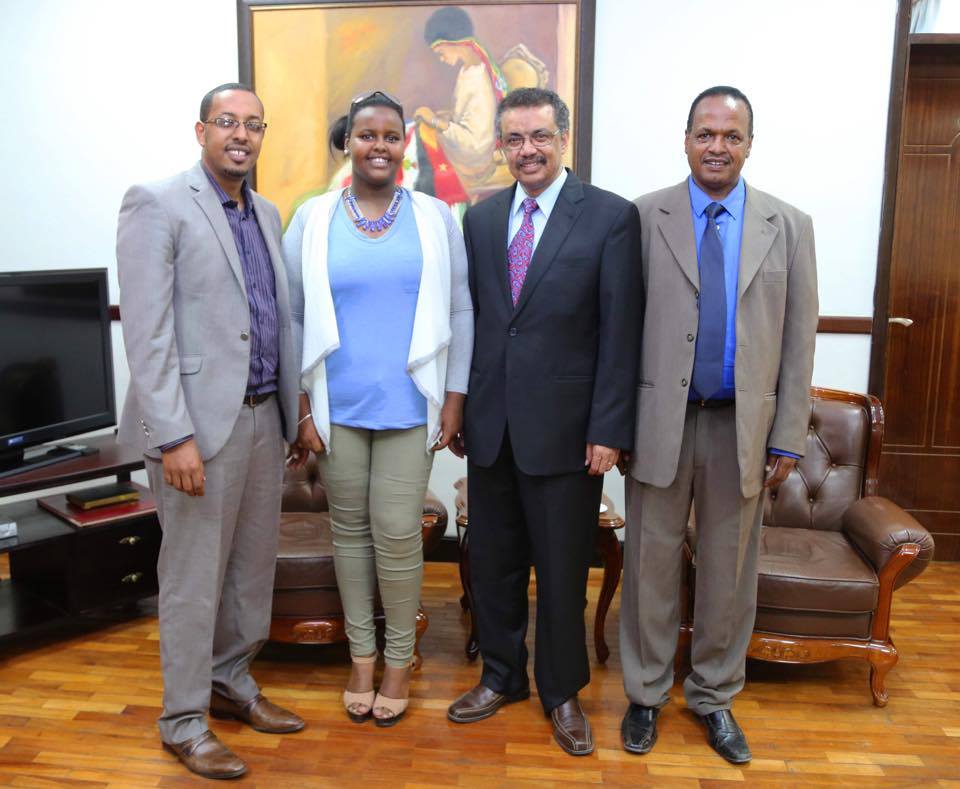
(Addis Voice) The Foreign Minister of Ethiopia has been caught in an explosive web of lies with a schoolgirl as the Government of Australia and the Rotary Foundation have denied giving 20 million Australian dollars to a 14-year old teenager, whom the nation’s “top diplomat” publicly praised and endorsed as an “exemplary philanthropist” and claimed her to be the winner of an unnamed “international prize”.
beritu and family 1.jpg
The Ethiopian-Australian girl, Beritu Jaleta Ahmed, claimed last week in a joint press conference with Dr. Tedros Adhanom in his own office that she was ready to build a school in Ethiopia with the 20 million Australian dollars that she won in a student competition held at her school in Melbourne. According to her, the prize money was jointly funded by the Australian Government and the Rotary Club of Australia [sic].
But Baden Powell College’s leadership, who knew nothing about the the competition or the prize, have already referred the matter to Victoria Police for investigation, Addis Voice has learnt. The public school that takes students from prep to 9th grade is dominated by students from immigrant families. It has around 1800 students, 180 staff and 50 volunteers. It gets an annual budget of around 12 million Australian dollars from the coffers of the Victoria Department of Education.
Tedros Adhanom publicly praised the teenager as a unique “role model” among the Ethiopian Diaspora for allocating such a large amount of money for development at such a young age. He commended her philanthropy and pledged that the government of Ethiopia would provide all the necessary support for the completion of the “modern school” project from nursery to secondary school levels that she planned build in Gara Muleta, Eastern Harargie, the birthplace of her father.
The Government of Australia and the Rotary Foundation have distanced themselves from the scheme and told Addis Voice that they have never heard of such a grand prize or the teenage winner of a multi-million dollars school competition. Some members of the Ethiopian community in Melbourne have blamed the girl’s father and the government in getting involved in such a shameful scam that can adversely affect the image of the country.
Jenna Hand, a spokesperson for Australia’s Department of Foreign Affairs and Trade, refuted the teenager’s claim that the Government of Australia gave her half of the prize money. In a written statement emailed to this reporter, the spokesperson said: “The Department of Foreign Affairs and Trade has not given 10 million Australian dollars to fund a school in Gara Muleta, Ethiopia. The Department of Foreign Affairs and Trade supports education in Ethiopia by providing core funding to the Global Partnership for Education. Ethiopia is a recipient of Global Partnership for Education funding,” the official Australian Government statement said.
The Foreign Minister had also maximized the PR “opportunity” by spreading and spinning the news, along with pictures of himself, the girl and her father, Jaleta Ahmed, on Facebook and Twitter. “Beritu Jaleta has done an extraordinary deed that we should all learn from,” he wrote on his Facebook page. Under Australian law any person under the age of eighteen is considered a child.
“I came here to Ethiopia to build a school in Gara Muleta, Harargie. I won a competition of 20 million Australian dollars. So I came here with the Embassy of the government of Ethiopia in Australia to begin my project and the construction and also see the area and the land,” she told journalists, who were not allowed to raise any serious questions during the press the stage managed conference held in the office of the Minister.
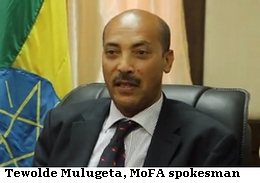
Tewolde Mulugeta, a spokesperson of the Ministry of Foreign Affairs, added a spin to the propaganda claiming that she received the award last year for her extraordinary academic performance and proposal to build a school. “She used to participate in various school clubs. One of the clubs was the one she headed in areas of human affairs. While she was working in that club, they were exchanging views regarding the support of people for others,” Tewolde said unconvincingly. “The main thing was that she proposed an idea to create opportunities for others to get education. We have learned that people who have heard the idea arranged the prize for her. This happened nearly one year ago, around 2014,” he claimed nervously without providing any proofs and verification.  official.jpg
Bruce Allen, Manager of Rotary International in Australia, pointed out that 1300 Rotary Clubs raised only $A 5.6 million dollars for its own humanitarian projects and activities last year let alone giving “an outrageous amount of money” to a 14-year old school girl. “It is totally out of question. There was no application or grant to this person,” he said.
“She is saying that half the money came from the Rotary Club and half of it from the Government Australia. There is no way that any Rotary Club in Australia could afford to pay that amount of money. We just don’t have the money. She got 20 million Australian dollars and I find it highly unlikely. That is an outrageous amount of money,” Mr. Allen noted. He also said that there is nothing called “Rotary Club of Australia” as the girl said because there are 1300 Rotary clubs in the country.
Bruce Allen.jpg
“We only have money for a whole rage of humanitarian programs. But we will never ever get involved to this extent. It is a lot of money and there is no Rotary Club in Australia that could afford to do that.There is a key point here. She is saying that half the money came from the Rotary Club and half the money is coming from the Australian government. There is no way any Rotary Club in Australia could afford to pay that amount of money,” he said.
So many puzzled Ethiopians took to social media to vent their anger and express their doubts on how the person in charge of Ethiopia’s foreign relations is unaware of unlikely global developments as well as the legal implications of corrupting the morals and psychology of a child by involving her in such an orchestrated web of lies and deceptions never heard of in the history of schools anywhere in the world without making any effort to verify such claims.
by 37 percent in a bid to reduce the cost of the national expenditure. From $A 225 million the previous year, the Government of Australia cut its aid to Africa to just 133 million AUD.What makes the story even more ludicrous and bizarre is the fact that during the 2013/14 budget year Australia cut its foreign aid to Sub-Saharan Africa
During the same budget year, Rotary Foundation gave grants totalling $14.2 million to support 265 projects worldwide in the areas of disease prevention and treatment that he foundation dispersed  totalling only $6.5 for education and literacy to support 66 projects around the world,  according to its annual report.
Meanwhile, the Baden Powell College administration declined to give any official statement. But a school source, who spoke on condition anonymity, told Addis Voice that the school officials are very upset and disappointed to be dragged into this kind of scandalous scam.
“Because the issue involves a minor and is also under investigation by the police, we are not authorized to make any public comments,” the source said. The motto of the school is “Looking Forward, and Staying Ahead.” It is not now clear if Mr. Jaleta Ahmed and his daughter are looking forward to returning to Australia to face the music or would rather stay in Ethiopia despite being caught in dangerous web of lies and scandals.

Saturday, February 28, 2015

The plight of Ethiopian migrants in Somalia

Hamza Mohamed |Aljzeera
Bossaso, Somalia - Ankles deep in brown canal water, freshly plucked green weeds in both muddy hands, Abdi Muse Kalon cannot stop grinning. He says life here has given him a second chance – a better chance.
Risking his life, Kalon walked for more than four months from Ethiopia to get to Bossaso, a port city nestled next to the Red Sea in Somalia’s northeast.
Kalon is one of at least 10,000 Ethiopian migrants who have crossed over from neighbouring Ethiopia and settled on the southern coast of the Gulf of Aden in the past five years, according to local authorities.
“It was not easy to get here, not everyone makes it. People die of starvation and thirst on the way here. And even wild animals can kill you. I’m very lucky,” Kalon told Al Jazeera.
He first tried his luck to come to Bossaso in 2009. With wages low and jobs hard to come by back home, Kalon saved enough money and boarded a boat in search of greener pastures. Oman was his final destination, but soon he was picked up by authorities in the Arab sultanate and sent back.
Unhappy with what life in Ethiopia offered him and his family, he decided Somalia was his next destination.
A cold welcome
Kalon and thousands of his countrymen are leaving one of the fastest growing economies on the African continent for a country that until recently was considered a “failed state”. This part of the Horn of Africa country has been spared the worst of the two decades-long civil war, and has had relative peace for the last 10 years.
But with seven out of 10 of Somali youth unemployed, the presence of these mainly economic migrants has caused tension. Residents want them out, by force if necessary.
The local government is leading the efforts to send the Ethiopians back. New strict laws have been put in place to curb the influx of migrants.
Any driver caught bringing in foreigners risks a fine of $300 and, or, a jail term.
Every vehicle coming into this city of more than half-a-million residents is thoroughly checked by armed soldiers. Anyone caught without valid paperwork is hauled off to an overcrowded prison before being deported back to their country of origin.
Landlords have been given firm orders not to rent their homes to the unwelcome guests, forcing Ethiopians into the harsh camps for internally displaced people on the city’s outskirts.
At these camps, they are at the mercy of raids by security forces and forceful deportations.
“We cannot cope with these numbers of undocumented migrants,” the town’s mayor, Hassan Abdalle Hassan, told Al Jazeera.
“Many times before we sent them back, but they don’t want to go back to Ethiopia. Now they come by foot because we told drivers not to bring them here.”
The mayor estimated that hundreds of new arrivals reach Bossaso every week. Some board rickety boats and later head to Gulf countries, but most remain in Bossaso.
“Depending on the time of the year we see between 200 and 300 migrants every week. That is way too many for us to accommodate,” Hassan said.
Working hard and thriving
But the government’s loud threats are falling on deaf ears. The migrants have taken over a whole neighbourhood of the city that until recently used to be exclusively inhabited by Somalis.
Restaurants, laundry shops and taxi services run by the new arrivals have not only opened but are thriving.
Every evening the streets of this part of Bossaso are filled with mainly young men from Ethiopia – Africa’s second most populous country – gathering around tea stalls. The evening ocean breeze blowing in from the sea is filled with the aroma of spicy Ethiopian food and music.
Less than a kilometre from the farm where Kalon works, a dirt road snakes through a large refugee camp.
Ahmed Abdi Muse sits in the passenger seat of a beaten-up car. He has been living in Bossaso for more than a decade and is fluent in Somali. He speaks the local dialect, making everyone second-guess his nationality. For the past five years, he has been working as a driving instructor.
“There are not that many choices for us but to stay here and do our best to provide for those close to us. Ethiopia is not an option for me, and going to Arab countries is very risky. We come here and work hard. We don’t harm anyone. We are here only to support our families,” Muse said.
The migrants are trying their best to be part of the wider community and have formed community organisations.
Mohamed Abadir is the chairman of the Ethiopian community in the Puntland region of Somalia – a semi-autonomous state in the northeast part of the country.
A resident of Bossaso for the past 20 years, he now owns a farm outside the city and employs 10 Ethiopians.
“Relations between the Somali people and our people are good, but not perfect. We live side by side in peace,” Abadir told Al Jazeera.
But life here as migrants comes with its own challenges.
“Because no one wants to rent houses to us, every Ethiopian family here is housing three other families. Housing is an issue. Apart from that we have a good understanding with our hosts,” Abadir said.
Despite the migrants best attempts to be a part of the local community, locals can’t wait to see them leave – for good.
“We are not happy with their presence,” said Abdi Noor Galayr, a vocal anti-migrant campaigner in the city.
“They have brought many problems in terms of health. We don’t know what health issues they may have. They brought criminals to this town like people smugglers. They are also putting pressure on the job market.”
Galayr and those like-minded might not want the Ethiopians in their city, but Kalon said he is going nowhere.
“Somalia is not home, but for now it is home. I hope to bring my wife and children when I have saved enough money. Life is better here,” Kalon said.


Source: aljazeera.com