Monday, May 2, 2016

FROM SURVIVANCE ALL THE WAY TO RECONSTRUCTION: THE OROMO PURSUIT OF EQUALIBERTY

  1. Introduction
A lot is happening in our part of the world. The last five months have been immensely eventful. We witnessed a series of tragic events unfolding successively one after the other, each more saddening than the one preceding it. These are truly hard times. Such times signal the urgency of prudent action. Reflexive action is the imperative of the time.
Over the weekend, when I was asked to comment on the ongoing Oromo protest in Ethiopia, I chose to reflect on the Oromo pursuit of social justice and political freedom, the pursuit of what Etienne Balibar calls ‘Equaliberty.’[1] In particular, I chose to reflect on the four critical phases of the Oromo struggle for national emancipation in order to express, if I can, solidarity with the national awakening we see in Oromia today. Specifically, I focused on the phases of survivance,[2] resistance, recovery, and reconstruction.
The primary aim for me personally is to pay attention and to remember and re-member. It is to pay tribute to the people, young and old, who have given and are giving their all in this most recent iteration of the Oromo national struggle for emancipation. The broader aim is to encourage all of us to look ahead into the future, where the Oromo will build walls of connection serving as a force for good in the region. It is aimed at encouraging us into the redemptive work of transformation of the entire Horn of Africa Region through a just peace, a peace that honours the ideals of Equality and Liberty (social justice and freedom). It is directed towards invoking what Ruti Teitel calls ‘Humanity’s Law,’[3] the law that emerged in consideration of the global inter-connectedness in the 21st century – and the law that enhances accountability for one’s actions in all corners of the world. I will argue that the success of this ongoing resistance, which some rightly call ‘Oromo National Awakening,’[4] depends on its capacity to engage with the world responsibly and re-constructively within the framework of Humanity’s Law.
  1. Phases of the struggle for National Emancipation
Since the time of their incorporation into Ethiopia in the 19th century, the Oromo have undergone four phases in their expression of indignation and resentment to the hegemony of the Ethiopian state nationalism. These phases can be summarized as follows: a) Survivance; b) Resistance; c) Recovery; d) Reconstruction. I hasten to add that there is hardly a clear demarcation between these phases as they not only flow into one another but also overlap. At times, they occur simultaneously. When they do so, or whenever any two of these happen together, as in the current Oromo awakening, the more successful they become, the more explosive in their intensity, the more powerful in their impact. When they come coevally, they tend to birth a rupture, even a revolution.
Let us have a quick look at what each stage involves.
  • Survivance: Insisting on Presence
At this stage of reckoning with loss and lamenting humiliation, the Oromo was engaged in a quiet performance of Oromumma in the privacy of their homes and/or in the non-penetrated spaces of the rural environment. Among other things, this stage is marked by a quiet resistance to cultural and physical extermination. It was a season of adaptation and adjustment, a season of quiet retreat into one’s own way of life. It is a season of practising Oromumma in the non-public space (in the privacy of the home and in the isolated corners of unpenetrated Oromo hinterland).  In urban areas, the Oromo tried to resist assimilation even as they performed a politics of passing and invisibility, making a gesture towards assimilation. In the rural areas, where the State was unable to penetrate the society, the resistance took the form of distancing oneself from the state. A typical practice in this regard is avoiding state schools for fear of being subjected to a repressive pedagogy of assimilation and erasure of their Oromo identity. The time from incorporation into the Ethiopian imperial state in the late 19thcentury to the 1960s can be characterized as a time of survival and of practising survivance.[5]
  • Resistance
This is the stage of refusal to be governed. This is the stage of saying NO, overtly and covertly. In its covert form, it sought to disperse the benefits of modern education and basic infrastructure among the Oromo without calling it an Oromo movement. This is what one sees in the early activities of the self-help association known as the Matcha-Tulama Association (MTA).  Of course, this kind of covert resistance is undergirded by a keen sense of awareness of oneself as an Oromo and of appreciating the uneven distribution of basic social services in the empire.
The most overt form of resistance started in the acts of rebellion and organized armed resistance in the 1960s. The age of resistance that started with the MTA movement in urban areas of the centre was corroborated by the Bale Oromo resistance also charting out the route (also in part contributing) to the subsequent Ethiopia-wide social upheaval and revolution of 1974. The more mature phase of resistance, of course, took shape only after the formation of the Oromo Liberation Front in 1974 to launch an armed struggle.
Fast forward, when the military regime was eventually toppled by forces of the periphery in 1991, this phase of overt resistance came to a close only to start after a season of recovery. The Oromo self-assertion as a self-determining agent to have a role in the reconstitution of the Ethiopian state as a democratic, human rights-sensitive, caring and compassionate polity committed to multi-foundationalism, plurinationalism, and just peace[6] was met by a military reprisal under an insecure Ethiopian regime that was reluctant to lose power for the sake of transforming the polity on democratic and humanitarian bases. The transition to democracy faltered and ultimately got derailed altogether. The politics remained militarized. The state crisis continued to deepen. When the OLF left the transition, the transitional pact signed among various liberation fronts collapsed. The hope of transformation was deferred.
The Oromo self-assertion came to be viewed as a threat to the national security of Ethiopia. Oromumma became a securitized identity. The Ethiopian prisons and detention centres started to be congested byOromos charged with the non-existent crime of being ‘anti-peace elements’ (the incipient form of what later became the discourse of terrorism). The politics of co-optation and patronage had led to the creation of the Oromo People’s Democratic Organization (OPDO) to rule Oromia on behalf of the Ethiopian regime, which was now under the tight grip of the Tigray People’s Liberation Front (TPLF). In order to secure a semblance of legitimacy in Oromia, however, the regime adopted the OLF’s program of recovering the Oromo language (Afaan Oromo), Oromo identity, Oromo culture, Oromo history, and all there is in between.
The seeds of recovery were already in the phase of resistance. However, the actual work of recovery started to bear fruit as it was intensified even in the midst of a violent repression unprecedented in a long time. While the Ethiopian regime utilized its good relations with the international community to malign the Oromos as terrorists and to exclude them from the public space, the Oromo took solace in the possibility of using their language, practising their culture, and manifesting their identity in public—albeit only to a limited extent. Later on, this act of taking comfort and pride in using language, expressing culture, and manifesting identitycame to express itself in the cultural turn the Oromo resistance took in the face of the increasing closure of the public (political) space.[7]
  • Recovery
This phase was a stage of ‘drawing breath.’[8] Although at first it appeared a moment of loss and defeat, it actually became a moment of recovery. It is amoment of finding our way back to our Oromo selves. It proved to be a moment of experiencing resilience in its full bloom. Almost like a national recess, it served as a season of rehabilitating the Oromo self, recovering and projecting Oromo subjectivity. It was a moment of reclamation of voice for the Oromo.
In particular, it was a season of recovering the language, the identity, the history (the narrative, the memories, and the stories), the culture, and the cultural institutions of the Oromo. It was a season of refurbishing our way of being in the world, a moment of re-presenting ourselves, counteracting the forced absence of the Oromo from the Ethiopian public scene. It was a moment of imagining home from exile. In short, it was a season of restoring dignity to the Oromo (even in the darkness of the unprecedented state terror from 1992-todate).
  • Reconstruction
The fourth phase is probably the most critical of all. This stage marks the season for the Oromo to take their legitimate place in the world. It is a stage of reconstituting the Oromo self in the context of a globalized world infinitely interconnected with other peoples. It is a season of reconfiguring the Ethiopian state. The work at this stage can be nothing but transformative. It is a work of engaging with Ethiopia, the horn region, the African Union, the middle-east, and the wider world. It is a moment of projecting an Oromo self that intervenes in the world as a force for good, as a responsible regional actor, as a responsible ‘international citizen.’
At this stage, as a people, the Oromo shall hopefully overcome the brokenness of our past, the deep fractures in our relations with the other peoples of Ethiopia and the Horn. In particular, the Oromo must pay attention to the Ethiopian State with a view to engagement for its genuine transformation. The Oromo pursuit of justice must be complemented by a responsible pursuit of democracy, if only to harness the political power needed to transform the state. Oromo pursuit of equality in citizenship can be a rallying point for all of the ‘other’ peoples (who inhabit the Southern and the peripheral half of Ethiopia). This demand for equality is at its root a question of justice, but we have now learnt the bitter lesson that justice is the function of (mainly legislative and judicial) power. The task of reconstruction cannot be done without pursuing some form of transformative power. The Oromo quest for equaliberty becomes a synthesis of individual rights on the one hand and the right of collectivities (as well as classes and other categories) to universal social equality. In a sense, this self-conscious and reflexive pursuit of power is a pursuit of a ‘strong democracy.’[9] Pursuing a strong democracy in a country such as Ethiopia, pursuing transformative power in this context, requires a huge sense of responsibility to reckon with the other (all the Ethiopian others) with an eye on reconfiguring the terms of citizenship, to reconstruct the state, and to transfigure the state-society relationship. This process of pursuing and achieving transformative power is an engagement in the task of redemption (a process of turning the essentially illegitimate into legitimate). [10]
Granted, it is a painful task. It requires looking at historical evil squarely in the eye, reckoning with its impacts, accounting for it, remembering it, but choosing to forgive.[11]It requires an agonistic engagement with our plurinationality and the complexity thereof. It comes with cost and sacrifice. For the Oromo, the price of equaliberty is a sense of national responsibility. This is because the work of reconstruction in Ethiopia demands nothing less than redemption. From theological discourses, we know that redemption requires sacrifice that invests in the belief that the future will be different from the past. It is a process that unleashes anguish as we try to undo injustices of the past and hope for a fairer and more just future.
Transformative engagement with Ethiopia requires consideration of several concrete political realities such as international debts, borders, and military engagements in the neighbouring countries and in the UN Peace-keeping mission fields. More importantly, it requires a serious look into the trade, investment, and development partnerships that Ethiopia has gone into and the obligations that flow therefrom. The Oromo also needs to engage creatively and imaginatively with the institutions of the Ethiopian empire. One has to have a clear idea of what to do with its repressive security, intelligence, military, police, and prison institutions. One also needs to have a clear idea of what to do with abused constitutional institutions and arrangements (parliaments, elections, federalism, self-determination rules, constitutions, ‘rule of law,’ etc). The most urgent and pressing challenge that the Oromo needs to counter directly is the arrest and eradication of the intermittent famine that is caused and mismanaged by successive Ethiopian regimes.
In the endeavour to transform the state-society relation, the Oromo needs to change the hierarchic, centralized, and authoritarian political culture of the country. When it comes to the issue of handling plurinationality and the demand for ethno-cultural justice, the Oromo needs to appreciate that there will be no post-EPRDF moment in some ways and find more practical and just ways of satisfying legitimate national aspirations at all levels. For this, the Oromo needs to empower citizens, preparing them for the democracy to come both within Oromia and in the wider Ethiopia. One needs to prepare people for making an informed sovereign choice in the deliberations on sensitive issues of self-determination and constitutional secession. Throughout, one needs to beware of what we inherit: huge amounts of international debts; an interlocked and inter-dependent but conflicting and volatile neighbourhood; chronic poverty; malfunctioning institutions; budding corruption in a bubble economy;a generally neo-liberal-capitalist global society; a US-driven civilizational cleavage in the ‘war against terrorism’; a deeply divided society; a society that is traumatized by decades of state terrorism; etc.
In the work of reconstruction, the Oromo ought to enact wholeness, connectedness, into the future. The Oromo now ought to become the people of promise, the people of hope. The Oromo ought to draw on their traditional values and institutions to actively pursue justice. They only need to remember that they are a people of legality (seera and safuu), a people of egalitarian rule (Gadaa), a people of peace (nagaa), a people of substantive justice (sirna dhugaa fi haaqaa), and a people of reconciliation (araara). In all this, they act from the space of brokenness they inhabit as a people who know, from lived experience, what it means to be oppressed. In engaging with the world from the position of brokenness and suffering helps the Oromo create that moment of inter-subjectivity, the space in-between, born out of the historic vulnerability.As Hannah Arendt reminds us, this place in-between is where the world is constituted. “The world is between people,”[12] she once said.
At this stage of the national struggle, the Oromo engage in the act of rebuilding. We build walls of connection, solidarity, humanity, and co-equal/human responsibility. It is at this historical stage that the Oromo takes advantage of the contemporary world’s law. Ruti Teitel calls this body of global law ‘humanity’s law.’[13] It is composed of the trinity of international human rights law, the law of war (humanitarian law), and international criminal justice. The first is chiefly a protective body of law (firmly rooted in the fundamental human dignity and worth). The second is more a remedial type of law that gets activated in times of crisis as  people conflict (going to war or engaging in other forms of political violence) and mistreat each other (in the context of war). The third is focused on ensuring responsibility for atrocities beyond one’s national borders. In this third category of law, the Oromo sees the International community as a truth bearing witness and a potential ally in the pursuit of their equaliberty. The third category, being mainly a post-sovereignty regime of law, also helps us overcome the weaknesses of traditional state-centred institutions of human rights and humanitarian law. It is this nature that makes it suitable to the concerns of sub-national entities that were routinely ignored or abused by the complicity of the national and the international actors whose conducts are anchored in the notion of sovereignty.
The Oromo of the 21st century, the brave new generation that is living this moment of awakening, has the task of reconstruction by paying attention to and taking advantage of the contemporary humanity’s law.   Humanity’s law helps us achieve human rights, peace, and justice, all three of them together. This in turn consolidates just peace in the entire region.  For the Oromo, apart from allowing us to engage the international (which was often neglected in the struggle although the latter was always attendant to our oppression from colonial times to cold war, and further on to this neo-liberal ‘global-capitalist’ age), helps us pursue equaliberty, i.e., both equality and liberty. The historic Oromo quest for freedom and social justice will then be achieved within this framework.
In the course of reconstruction, the Oromo engage in self-transcendence. They live out the imperative of paying attention as an act of solidarity with all oppressed people around them. They reach out to all their neighbours, especially the humble and the lowly. And these are in abundance in the region, be it in Ethiopia or in the wider Horn region. Without reaching out to these and working together with them, Oromia can hardly achieve freedom, justice, or peace.
  1. Pursuing Equaliberty: The Imperative of Resistance, Recovery, and Reconstruction
The Oromo pursuit of equaliberty in the framework of humanity’s law, unlike what its detractors maintain, is not a quest for power. Nor is it just a quest for thin democracy as experienced in electoral practices. It is primarily a quest for social justice in a democratic environment that is grounded in a sense of responsibility for the protection and elevation of human dignity. In this process, the Oromo is going to go beyond resistance and self-recovery to achieve reconstruction with an eye on reconciliation. This is necessitated by the fact that both freedom and justice, both liberty and equality, are intensely relational. No time is more suited than now for us to proclaim, in the spirit of Ubuntu, that “I am because we are.” No place needs this spirit in abundance more than do Oromia and its neighbourhood.
  1. After the Oromo Protest: the Imperative of Reconstruction
In the past few years, we have witnessed among the Oromo the simultaneous operation of the logic of recovery and resistance–sometimes alternately, sometimes simultaneously. The stronger the repression, the more powerful the momentum of the resistance. The generation that benefitted from the cultural rehabilitation has come of age to demand their right in their own terms. In the last five months we have become fortunate to see a generation that is mentally emancipated, a populace that knows how to conduct itself in the face of adversity, a people who act cohesively with a unity of purpose. We have seen the persistence in resistance.
We have seen a people determined to insist on justice. A people who turned (economic and electoral) despair into hope, loss (of land and livelihood) into gain, (electoral and military) defeat into (a genuinely substantive political) victory.
We have witnessed a people who, with their resilience, exposed the moral and political bankruptcy of a conceited regime. We observed a self-mobilized, self-directed, grassroots movement that virtually shamed and humiliated a seemingly invincible regime. We have seen people expose the limits of deceptive politics whose legitimacy is shored up through using election as a war by other means. We have seen a people who tested the limits of political double-speak. We have seen a people who exposed the true nature of the regime. They have rendered a region totally ungovernable. They have forced the regime to impose a military rule.[14]
We have seen a movement that conducted itself responsibly vis-à-vis other peoples even in the face of provocation and manipulation by the regime to foment horizontal conflicts.
This is an indication of the fact that the Oromo public is now ready to engage the wider Ethiopia, the entire region, and the world re-constructively, transformationally, redemptively within the framework of humanity’s law. The success of this National Awakening is to be completed when its leaders demonstrate thecapacity to make the generation to begin again, to start afresh, to remake the neighbourhood, to build new walls of interdependence, even from the ravages of our oppressed Oromo lives. The success is said to be complete when the Qubee Generation demonstrates its capacity to write a new history by emulating the Phoenix that “rises out of the ashes”, to go beyond the ruins imposed on it by a century of injustice to make a difference in the region.
For this, we need to start paying attention to connectedness, inter-dependence, and the need for acting in solidarity with others. After all, as Simone Weil reminds us, paying attention is an act of grace, the ultimate expression of solidarity. Like all the other peoples in Ethiopia, the Oromo ought to start learning to see through others’ lens. We have a fear to dispel. We have a trust to build. We have the responsibility to enchant the generation into hope and a better future.
  1. Conclusion
The current Oromo awakening reminds us that the Oromo have survived. The age of being seen as an unwanted presence, as a vestige of a regrettable past in Ethiopia, is substantially on the decline. The work of national self-recovery has borne fruits.TheQubee generation is already here to make a difference.The children have arrived. Resistance has matured, especially in the way it conducts itself horizontally. But in the main, it has restored agency to the Oromo public, who in turn have made Oromia totally ungovernable to the regime. Mental emancipation has been achieved.
People now know how to act, and can act, even in desperate conditions. What remains now is to start engaging wisely with the world around us in the task of reconstruction.  Prudence suggests that we can take advantage of humanity’s law. Prudence also suggests that we be mindful of the fact that in our times, lawful engagement is a necessity. Yes, law, too, can be effectively—albeit discerningly—be used as a spectre of resistance and a useful means of reconstruction. We need to remember that more often than not, law is deployed as ‘war by other means.’ It is this interlocked deployment of law in/and war that David Kennedy calls lawfare[15] (war by legal means), and perhaps rightly so. The flip side of this is that law can be deployed to build connections, relations, and peace thereof. I hope the Oromo national awakening will make optimal use of thislawful form of engagement with the world.


ED’s Note: Tsegaye Ararssa is from Melbourne Law School. He can be reached at:tsegayenz@gmail.com.  The article was prepared as a remark for the ‘RIGHT TO FREEDOM’ event organized by Oromo Support Group Australia, 16-17 April 2016, Melbourne Australia
 End Notes:
[1] Etienne Balibar, Equaliberty:Political Essays, Tr. James Ingram. (Duke University Press, 2014).
[2] The term ‘surv

ivance’ is used among scholars working on the issues of First Nations (also known as indigenous peoples). I came across the term for the first time in the work of Gerald Vizenor, Manifest Manners: Narratives on Postindian Survivance (Nebraska, 1999). The term means a lot more than mere survival. According to Vizenor, “Survivance is an active sense of presence, the continuance of native stories, not a mere reaction, or a survivable name. Native survivance stories are renunciations of dominance, tragedy and victimry.” In Derridan sense, survivance of course refers to “a spectral existence that would be neither life nor death.” The Oromo struggle in its first iteration soon after the conquest was more like survivance, especially in its quest for active presence in the Ethiopian polity.

[3] Ruti Teitel, Humanity’s Law (Oxford University Press, 2011). Teitel identifies three important components that constitute ‘Humanity’s Law’: International Human Rights Law; Laws of war (traditionally known as humanitarian law, i.e., the law IN war and the law OF war); and International Criminal Justice (following the creation of the International Criminal Court via the Rome Statute). Humanity’s Law, Teitel argues, is the new framework of understanding ‘transitional justice’ in the context of changing global relations. I follow her tack and suggest that this law lays the framework for solidarity and responsibility in an increasingly interdependent world.

[4] I am indebted to Nageessaa Oddo Dube for this phrase. Nageessaa used the phrase in his recent speech televised by Oromo TV on 16 April 2016, also available at https://www.youtube.com/watch?v=MF4SskY660A.

[5] One notes, however, that the formation of the Western Oromo Confederation in 1936 and its act of approaching the League of Nations for membership, or alternatively seeking a British Protectorate instead of submitting to the Italian invaders, was an early and short-lived expression of overt resistance to the hegemony of the Ethiopian empire and an assertion of Oromo subjectivity in the international system of the time. See Ezikiel Gebissa’s ‘The Italian Invasion, the Ethiopian Empire, and Oromo Nationalism: The Significance of the Western Oromo Confederation of 1936,’ 9 Northeast African Studies 3 (2002), 75.

[6] A commitment also inscribed in the 1991 Transitional Charter of Ethiopia and later in the preamble of the 1995 Constitution of Ethiopia. To an extent, this undelivered promise of the constitution was what made the political elite of Ethiopia’s South (including the Oromo) ambivalent in their reaction to the constitution. It was also this promise that TPLF used to co-opt several Southern nationalists.

[7] This increasing use of songs, cultural events (such as Irrecha), exhibitions, etc to express political disaffection is recently referred to as the ‘cultural turn’ in the trajectory of Oromo national struggle. See Ezekiel Gebissa, “Land, Life, and Leadership” [?] (Dec 2015, OSA Extraordinary conference on the Master Plan).

[8] Alison Phipps, ‘Drawing Breath: Creative Elements and their Exile from Higher Education’ Arts and Humanities in Higher Education, 9(1) (2010), 43.

[9] Benjamin Barber, Strong Democracy: Participatory Politics for a New Age (20thanniversary ed) (University of California Press, 2004).

[10]This is inspired by a thought in Richard Dehmel’s poem, Transfigured Night (Verklarte Nacht) (1998) in which the conception of a child by an adulterous wife is transfigured by the light of love, also represented by the moonlit night, to bring infinitely more joy and rejuvenation to the husband. I like to suggest that this kind of redemptive transfiguration helps us overcome ‘constitutional original sins’ in order for us to go beyond the original constitutive wrong.

[11] An imperfect but useful institutional model in this regard is presented to us in the example of the South African Truth and Reconciliation Commission.

[12] Hannah Arendt, Men in Dark Times (Harvest Publishers, 1970).

[13] Ruti Teitel, Humanity’s Law (Oxford University Press, 2011). See also her ‘Humanity’s Law: Rule of Law for the New Global Politics,’ (2002) 35 Cornell Journal International of Law(2), 356. Teitel tries to work out a new framework of accountability at the global level by going beyond her earlier work on Transitional Justice (Oxford 2000). This framework, I hope, will be useful for the Oromo both to pursue justice for the atrocities experienced and to engage with their neighbours responsibly. Coming as they do out of a long and deep crisis situation, the Oromo can also use this framework for building a sustainable peace grounded in justice and truth.

[14] Contrary to what many people assume, what exists in Oromia now is not Martial Law. It is a pure military rule devoid of any semblance of legality that one sees even in Martial law (a rule under the command of the highest military official that suspends or deposes political leaders because of a constitutional crisis or utter incompetence on the part of civilian political governance).  In Ethiopia, what we see is an illegal dismissal of the state’s civilian administration by a Command Post chaired by the Federal Prime Minister who ordered, again illegally, eight divisions of the Army to “take a merciless and final measure” on protestors.

[15]David Kennedy, ‘Laware and Warfare’ in Cambridge Handbook of International Law, eds. James Crawford and Martti Koskenniemi (2012), 159, and David Kennedy,Of War and Law (Princeton University Press, 2006).

ANALYSIS: ETHIOPIA’S SIMMERING SORES AND THE RE-OPENING OF OLD WOUNDS


Cover edited

Kalkidan Yibeltal & Tesfalem Waldyes

The current government in Ethiopia, the Ethiopian Peoples’ Revolutionary Democratic Front (EPRDF), often claims the multi-national constitutional federalism that it introduced a quarter century ago answered the country’s age-old question – famously known as the ‘national question’ – once and for all.
Ethiopia’s constitution, the government further claims, is multi-foundational by its nature and adequately addresses the politics of recognition and inclusion for Ethiopia’s long marginalized nations; better yet it guarantees the right to self-determination up to secession. States are now autonomous and free from the yolk of a centralized state and the notion of “one country, one people, and one language”, a notion that had violently governed Ethiopia’s oppressed mass for at least a century.
Regional States
Today’s Ethiopia is a ‘federal democratic republic’ of nine autonomous national regional states: Afar, Amhara, Benishangul-Gumuz, Gambella, Harari, Oromiya, Somali, Southern Nations Nationalities and Peoples Region (SNNPR) and Tigray. All of them home to an incredibly diverse and free people, so the story goes.
For the last two decades, therefore, anyone who questions the accuracy of these narratives is labeled as an outright enemy of this unique polity, a polity born out of its people’s age-old grievances where “unity in diversity” is the order of the day.

Trouble in paradise
But a five month persistent protest by the Oromo, Ethiopia’s largest ethnic group, for whom the inaugural of a multi-national constitutional federalism was a long awaited victory, which started in Nov. 2015 has laid bare the otherwise flawless narrative Ethiopians have believed in for more than two decades. What began as an opposition against a The Addis Abeba Master Plan, which was, by any legal standard, prepared in a clear violation of the fundamental principles of federalism, led to historical questions that the Oromo of a federated Ethiopia continued demanding an answer for, including the questions of national identity, of economic injustice and land ownership as well as a genuine political representation.
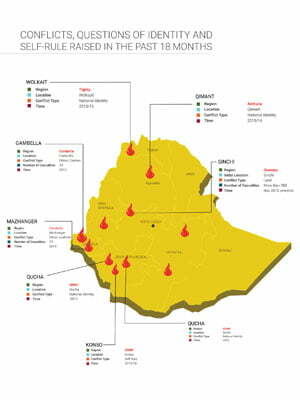
Info Graph 1
However, a look back at just the last eighteen months alone reveals that the Oromo are not the only ones that seem to be haunted by the re-opening of the old wounds that Ethiopians thought were treated two decades ago.
Incidents that resulted in the killings of hundreds, mass arrests and disappearances as well as displacements of thousands of Ethiopians in the hands of the state security apparatus show that the questions of national identity, the urge for self-administration and equitable use of resources (mainly land) and lack of adequate political representation have re-emerged afresh in five out of the nine independent regional states in the federated Ethiopia.
The ever restive Gambella
Home to around 200, 000 people, the Nuer, Agnuak, Apana, Mezhenger, and Komo are the main indigenous peoples of Gambella. But it is also home to other ethnic groups from the country such as the Amhara, Oromo and Tigray. According to a 2007 census, of the total ethnic composition in Gambella the Nuer consists 40%, followed by the Agnuak who make up 27%, Amhara 8%, Oromo 6%, Mezhenger 5.8%, Keffa 4.1%, Mocha 2%, and Tigray 1.6%, as well as other ethnic groups mainly from various regions in Southern Ethiopia who constitute 5.5%.
Unlike the triumphant declaration of a constitutional federalism however, Amharic, which is the mother tongue of neither the Nuers, nor the Agnuaks, is the working language of the State.
Historically, Gambella is a region prone to ethnic conflicts. The 2003 unprecedented massacre of more than 400 Agnuaks in the hands of government security forces and ‘highlanders’, according to the HRW, left Gambella stuck in crisis watch list of several international organizations including the United Nations.
What happened at the end of January 2016 can therefore be easily taken for the usual sporadic skirmishes between the two dominant ethnic groups; it involved both and covered vast areas in the region, touching villages from Abobo to Itang, Gog to Jor, and a refugee camp in Pugindo, as well as a prison cell in the capital, Gamebella town. By the government’s account 14 people, including Gatdet Gony, Deputy Head of the Transport and Road Development Office, were killed in the clash. Several other accounts put the number as high as 50.
The federal government quickly dismissed the cause as a simple confrontation between two men from both tribes, but the cumulative fear by the Agnuaks about the Nuer’s political dominance (which is often alleged to be supported by the federal government) and near absolute control over resources by the Nuer plays a significant role in instigating these conflicts.

Gambella’s small nuisances 
While the rest of Ethiopia was welcoming the Ethiopian New Year of 2007 on Sept 11, 2014 with jubilant festivities, Meti, a small town in Godere District in Mezhenger Zone of Gambella was struggling to contain a chaos that besieged the villagers. Around 8 AM that morning a group of men broke into a prison located in Kebele 01 and released several inmates who then went door to door to residences of the ethnic Mezhengers, killing many including women and children, according to charges brought against the perpetrators.
The Mezhenger consider people who came from various parts of the country, mostly from the highland areas of the North and Central Ethiopia and had settled there as ‘highlanders.’ Some of these ‘highlanders’ had lived in the district for decades.
Although the flare ups of many of these conflicts always come in the form of petty individual confrontations between the ethnic Mezhengers and these ‘highlanders’, the fundamental problem is one that Ethiopia’s two decades old constitutional federal dispensation failed to address effectively.
The Mezhenger zone is one of the three zones in Gambella bordering in its southeastern part the Sheka and Bench Maji zones of SNNPR, as well as the Agnuak of Gambella and Illubabor of Oromiya to the north. Endowed with abundant natural resources it is a region where the long arms of the federal government easily tampers with. The area is home to large scale tea plantations owned by foreign companies and fertile lands contracted to both local and foreign companies without much say from the Gambella regional state.

A recent report by Fortune newspaper, a private weekly, revealed that “Nearly 100 commercial farming investors in Gambella are losing thousands of hectares of land because the region leased by mistake lands under federal jurisdiction.” When asked to comment on the issue, Gatluak Tut Kon, president of the Gambella regional state, told the newspaper, “You should talk to the federal government. I wish to give no comment on the case.” For many who believed in the principles of constitutional federalism that Ethiopian officials claim to have instilled, this was no ordinary news headline.

Critics also lament that the demands of the Mezhenger people to want to forcefully evict “highlanders” from their native land comes from the insecurity of resource distribution and a sense of political exclusion. They were always Ethiopia’s marginalized periphery.

 Konso, Qucha, Wolkait, Qimant and all that demand
Following the creation by the SNNPR regional state of the Segen Area Peoples Zone in March 2011, the Konso community in the south was staging peaceful protests for the last 10 months. The Konso people fear the creation of the new zone forces them to lose their “right to self-administration and their right to advance their culture, language and national identity, enshrined in the constitution.”
The response from the regional government was similar to the response the federal government often avails to contain similar demands elsewhere: deploying the region’s Special Forces who asnwered the community’s constitutionally legitimate demands with violence.
Although to a lesser extent, the Qucha people, who also reside in the SNNPR regional state, are demanding a similar question: the right to self-administration. Forty elected representatives of the community have come to Addis Abeba at the end of 2014 and have raised the question of national identity and self-rule with the House of Federation.
In the north of Ethiopia the Qimant people in the Amhara regional state, north of Gondar, also demand what the Konsos and Quchas were demanding for years. A recent conflict that flared up in Nov. 2015 between the Qimant people and the regional administration is believed to have resulted in the death of several community members of the Qimant people.
However, contrary to the people of Konso and Qucha, (and rather uncharacteristic of the regime), the Qimant peoples’ demand for self-administration was addressed in March 2015 when the Amhara Regional state granted them a status of nationality and ruled that they can exercise self-administration. According to the ruling, the Qimant have a right for self-administration in 42 Kebeles in the adjacent Armachiho and Chilga Districts. They can also enjoy the full rights of developing their language as well as their culture.
In north western Ethiopia, the simmering question of national identity by the Wolkayit community has recently reached a new peak. In what’s largely believed to be a forceful decision by the federal government, the Wolkayit people are to stay under the Humera Zone of the Tigray regional state. It is a decision that quashed the community’s two decades old demand to join the Amhara regional state, as they identify themselves as Amharas. A few weeks into the protest the people of Wolkayit were paraded in front of the national TV carrying placards that declared all their questions, including their questions of identity, as have been answered once and for all.
But as the bumpy road continues to stretch from the North to the South to the West (and seem to grow by frequency as well as magnitude) the first – and perhaps most uncomfortable – step would be to probe if Ethiopia, where the concept of “unity in diversity” avails itself for all to indulge on an equal footing, was ever born in the first place.

Worry or not worry?
Ezekiel Gebissa, a Professor of History and African Studies at Kettering University, argues that the constitutional federalism the incumbent introduced doesn’t originally belong to it; it dates back to “the Ethiopian student movement” of the early seventies.
Cover 59 B Prof. Ezekiel Gebissa
Prof. Ezekiel Gebissa
At the pinnacle of the student movement the question of national identity took center stage, especially among the movement’s leaders such as Walelign Mekonnen.  Walelign’s prescription of self-administration up to cessation for the politically marginalized became the rallying factor for the would-be guerrilla fighters, who later defeated the Marxist Derg regime, Prof. Ezekiel explains.
Although the Derge tried self-administration based on different regions called ‘autonomous provinces’, it was a system that didn’t save the center from an eventual collapse. With the coming to power in 1991 of the ruling EPRDF, therefore, having constitutional federalism was not an option but a necessity, according to Ezekiel.
Tamrat Kebede, Executive Director of InterAfrica Group, a think tank, agrees.  In addition, he sees the country’s journey from an absolute monarchy through military dictatorship to a constitutional federalism as “a quantum jump”. He believes that with the coming into power of the EPRDF questions of national identity and self-determination were put to the test for the first time. Himself a former member of the seventies’ student movement, Tamrat argues that as much as the questions were debated and discussed, the approach was purely theoretical.

Tamrat Kebede
Tamrat Kebede
Both Tamrat and Ezekiel find the government’s claims that the current constitutional federalism has answered Ethiopia’s age-old questions as exaggerated.
A careful look at the lingering cases of the Konso, Qucha, Wolkait and Qimant reveal the uncanny similarity each community’s approaches share to put their constitutionally guaranteed demands to the attention of the federal government; they all invoked legal mechanisms enshrined in the structures of the constitutional federalism. “The skeleton of the structure is in place. But putting it into policy is one thing, implementing it is another,” Ezekiel says.
When the Konso people began to protest the demotion of their administrative area from the status of Special District to a mere District, they formed a representative committee to advance their demand for self-administration and managed to collect signatures from more than 5% of the community, well above the constitution’s requirement. The committee then appealed to the Federal House of Federation here in Addis Abeba but the House sent the people (and their questions) back to the regional government.
Similarly the Qucha people, who are currently administered under the Gamo Gofa zone of the SNNPR, say that they are not ethnic Gamos, as the current arrangement dictates; they are their own nationality – Qucha. Qucha District, which is home to the Qucha people, has close to 150, 000 people, according to the 2007 national census.
And a committee gathered to address the question by the Wolkait people has written a letter on December 2015 to the House of Federation demanding proper response to their question of identity. The committee says that the Wolkait’s right to work and learn in their own language as well as their right to promote and advance their culture have been suppressed in the past, including the 20 plus years of the rule by the EPRDF.
But these glitches do not make Tamrat of InterAfrica Group lose faith in the constitutional federalism Ethiopia is following. In his interview with this magazine Tamrat says practicing a complex federal system such as that of Ethiopia’s will “inevitably run into enormous constraints and challenges.” “[such a system] entails decentralization; it is sensitive; it requires capacity, both in human terms and resource terms, which are not all readily available when you launch into such a complex arrangement,” Tamrat said.
Prof Ezekiel shares Tamrat’s view: adjusting the system itself as needed, “requires a careful, thoughtful, deeply concerned implementation” he says. But Ezekiel is critical because that never happened in the last two decades. “The question that brought the very existence of Ethiopia into a country was never fully answered”.
The reason for this, according to Ezekiel, lies in the undemocratic nature of the incumbent. Once in power the EPRDF “thought that they could do whatever they want; they could engineer any outcome; they could muzzle dissent; they could decimate opposition and tell the politically marginalized nationalities on the highland and on the lowland that ‘you have a constitution, your questions have been answered and you have no other question’”.
He believes that the questions raised now in different parts of the country are indeed not “new questions”. “They are the same questions” he told this magazine. However he doesn’t “believe for one minute that questioning the very foundation of the federal arrangement is the answer. It is whether it should be implemented or not.”
Darkness before dawn?
Analysts who follow Ethiopia closely argue that recent incidents happening in all corners of the country: the demands for economic justice, self-administration and national identity are symptoms of a disease far deeper than the current government dares to admit. Tamrat is one of them.
“These signs should force us to question what it is that we are not doing right,” he says, “or why is this structure we have created to precisely avoid these kinds of problems creating these problems? Could it be that we issued rights that are not being exercised? Have we not prepared ourselves for the manner in which they are to be exercised? That could very well be,” he says.
For him the recognitions of the identity and equality of nationalities as well as the rights to exercise self-administration up to the level of cessation manifests “strong rights which demand fair resource sharing, fair political participatory process, needless to say a democratic culture, in the absence of [which] they are bound to erupt.”
Ethiopians’ questions of national identity and the demand for self-rule are re-emerging frequently because they have never been answered in the right way, argues Ezekiel. “Ethiopia is still a one party state” in which not only its marginalized but also a great many are simply excluded from the political process.  And it is not just a theoretical exclusion, he said, “it is a totalitarian control of the assets of the state to give permanency to the exclusionary politics that the regime has put in place.”
The ruling party, Ezekiel further said, “uses the state resources to co-opt the military, the security apparatus and the business class” to “create a total hegemony of structure and discourse” and to “emasculate the very constitution it celebrates.”  The ruling party also puts an executive manned by “ill-educated party cadres that simply parrot the leaders’ pronouncements without any understanding of the complexities of implementing [federalism] policies.” The trajectory of this direction is one that’s “leading to calamity.”
Ezekiel believes that the disastrous handling by the federal government of almost all of these incidents (such as disarming regional police, intervention without due parliamentary process, committing crimes with an absolute sense of impunity and several other signs showing excessive control of the federal government against these national regional states) show that the party that likes to take total credit for creating Ethiopia’s constitutional federalism is becoming the system’s enemy number one.
Tamrat too shares Ezekiel’s concerns. The government’s ways of handling public resentments, which include the application of excessive force, does not manifest proper and competent handlings.
Campaigners and activists say the recent widespread public protest in Oromiya, which saw the federal army being quickly deployed, left more than 400 killed, twice that number injured, and thousands incarcerated. The federal army roamed many of the streets where protests broke out; and the whereabouts of hundreds of people remains unknown.
Members of the Konso community said that several of their people, including their leader, are incarcerated or have unjustly lost their jobs following their demand for self-rule, although many of them were released since the writing of this story.
According to a December 2015 letter addressed to the House of Federation by a committee gathered to discuss the question of the Wolkait people, there were about 116 people whose whereabouts were unknown because they raised “a question of identity.”
Going to the Qucha community in the South, in January 2015 the Gamo Area High Court has sentenced 27 members of the community to up to 16 years imprisonment for allegedly instigating violence and causing damage on people and properties fourteen months earlier. According to the charges presented against them, they were trying to operate illegally to forcefully obtain a status of nationality for the Qucha community. And to advance their cause, the charges add, they attacked residences of Kebele officials.
For Tamrat, some of the challenges the country is struggling with currently require an expanded political space, “to be debated, to be discussed, to [bring forth] appropriate responses. I see a deficit in that regard,” he says.
The government’s dogmatic obsession with the constitution is another “often overlooked” aspect for Tamrat. For the incumbent, the Constitution is non-debatable, fixed entity, probably because it mistakenly equates “the Constitution for law and order. So whenever it says the constitution [is beyond any discussion], it is actually saying that law and order are [beyond any discussion].”
Yet, the Constitution is an embodiment of a document that entails the compromise of different views and it is not static, argues Tamrat; it could be and should be amended when issues demand so. In fact “there is a provision that stipulates its own amendment” because amendment was “an envisaged process.” Article 104 clearly states the legality of “initiation of Amendments.”
“Any proposal for constitutional amendment, if supported by two-thirds majority vote in the House of Peoples’ Representatives, or by a two-thirds majority vote in the House of the Federation or when one-third of the State Councils of the member States of the Federation (by a majority vote in each Council) have supported it, shall be submitted for discussion and decision to the general public and to those whom the amendment of the Constitution concerns,” the Article reads.
A change towards democracy is a must if the country is to avoid regrettable tragedy, Ezekiel says. “People at the top of the government must know that the status quo is not sustainable”, he argues, “because there is too much discontent, too much dissatisfaction, a lot of desperation, a lot of deprivation,” Ezekiel said, adding that the government must stop listening to the reverberation of its own voices and understand that this is not a sustainable path.
“It should begin by decriminalizing dissent, open up the political space, expunge the draconian laws that are muzzling the press, start from the freedom of the press, release political prisoners. These are the measures the government could take in order to win the good will of the public,” Ezekiel said. “This is not an option, this is an imperative. The window will close sooner or later. But, would the government be able to see that? Well, I always say absolute power dements more than it corrupts.”
No turning back
Several Ethiopian critics of the government assert that the fundamental problem of the recent conflicts that besieged several areas is the constitutional federalism itself. According to these critics, it focuses more on differences than unity. Some fear it may even lead to an eventual disintegration of the country. A return to the old unitary system of administration is an idea whose appeal seems to gain increasing popularity among many Ethiopians. But it is an idea both Tamrat and Ezekiel strongly disagree with.
“The [current] federal arrangement was a response to a historic question of nationalities,” Ezekiel says, “to deny that there is a question of nationalities is to deny the sun rises in the East.” The country, according to him, has tried the unitarists as well as the assimilationists track for decades and it actually led to “proliferation of centrifugal forces”. Thus, “the claim that says we need a unitary state is a flight of fancy that collides with reality.”
Tamrat adds “a unitary government has not yielded the desired, harmonious and peaceful relationship. We can’t go back to a unitary system that’s held by force. We have travelled enough distance in this federal system in which national senses of identities have taken a right recognition and it is this right recognition which is manifesting itself as demands of right.”
But back in the power corridors of the government in Ethiopia exhausting propaganda is being relentlessly produced and aired through state affiliated media claiming that the federal arrangement not only answered the ‘national question’ but also put the burning question of land ownership, and the nation’s quest for self-rule, which saw the previous two regimes toppled by the will of the people, to their final resting place.
But to put Ezekiel’s words in this context, this one too seems “a flight of fancy that collides with reality.”